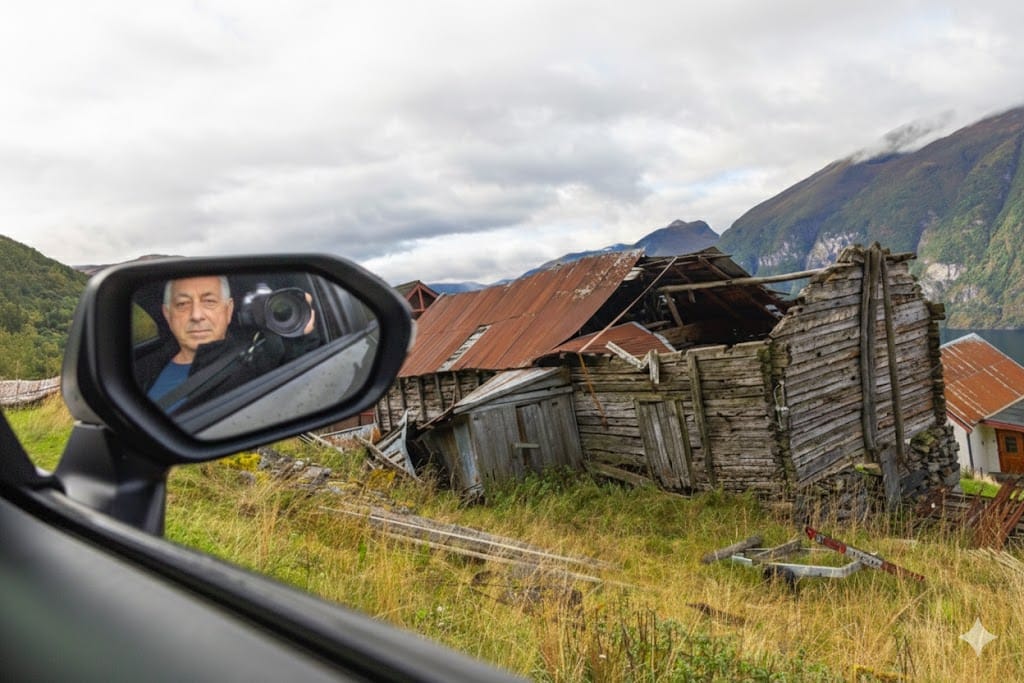
The Story: As we traversed the rugged landscape of Norway, I was not waiting for the car to stop. I set my Canon R5 Mk II to 1/2000th of a second, capturing a rapid-fire sequence of the passing scene from the passenger seat. This is opportunistic shooting at its most literal: roughly pointing the lens and trusting my eye to find the frame later. This was not a drive-by snapshot; it was day fourteen of a thirty-day immersion. By this point, my eye had adjusted to the Norwegian palette. Even at speed, I could recognise the specific silver-grey of a weathered barn that had stood for a century. In the wing mirror, I see a brief reflection of myself: the observer observed. It serves as a reminder that even when moving through a landscape at pace, the artist is never separate from the scene.
The Revelation: The raw shot included the wing mirror, the road, and a blur of scenery. But within that frame was a hidden masterpiece: a weathered structure, its textures etched by the North Sea air. A heavy crop usually signifies a loss of integrity, but here, it is a rebirth. Through the initial refinement in Topaz Photo, I restored the
foundational clarity of the capture. Later, I utilised Topaz Gigapixel to reconstruct the detail, creating an 18,000 x 12,000 pixel image to a crystal clear exhibition standard. By leveraging the R5 Mk II sensor
and AI reconstruction, I am able to pull a massive masterpiece out of a fragment, ensuring the final print is as sharp as the cold Norway air. What started as a fleeting glimpse at highway speeds became a
large-format archival print.